Sanjeevani
AI Mobile Health Unit (AI-MHU)

Nine conditions. One visit. One van that comes to the village.

A woman in a remote district would need four separate journeys, four separate queues and four separate reasons to take a day off work to be screened for what Sanjeevani checks in a single morning — in her own village.
Sanjeevini

Late is the most expensive way to find a disease.

Cancer, tuberculosis, diabetes and anaemia are all treatable when caught early. In rural, tribal and underserved districts they are usually caught late — not because the medicine does not exist, but because the distance does. A specialist is hours away. A day spent travelling is a day’s wages lost. So people go when something hurts, and by then the disease has had years.

Screening programmes exist, but they run separately: one campaign for TB, another for cancer, another for anaemia. Each asks the same person to turn up again.

The Burden

India
63% of deaths in India are caused by non-communicable diseases
2.38 lakh new breast cancer cases estimated in 2024
~78,500 new cervical cancer cases estimated annually
~2.81 lakh oral cavity and pharyngeal cancer cases estimated in 2024

Found Too Late

Early Detection
~1 in 2 breast cancer patients present at an advanced stage *
<2% of eligible women have ever received cervical screening *
60–80% of oral cancer patients present with advanced disease *

Undetected in Rural India

Rural India
1 in 4 rural adults have hypertension
~57% of people with diabetes are estimated to be undiagnosed
1 in 7 rural people with diabetes have diabetic retinopathy
25% of the world’s TB cases occur in India — the largest national share

Anaemia in Rural India

Rural India
59% of rural women aged 15–49 are anaemic
54% of rural pregnant women are anaemic
68% of rural children aged 6–59 months are anaemic

Sources: MoHFW / NP-NCD; ICMR-INDIAB; NFHS-5; WHO Global TB Report 2025 (India’s share of global cases in 2024); published Indian epidemiological studies.

India has screening programmes. Reaching people early and close to home is the hard part.

Silent disease doesn’t trigger a visit

Hypertension, diabetes and early cancers cause no pain. Nothing tells a person it is time to seek care.

Diagnostics sit far from the village

Mammography, chest X-ray and retinal imaging are concentrated in towns and cities, not where people live.

Too many barriers between the person and the test

Each step is a reason to stop.

Travel → Transport cost → Lost wages → Waiting → Multiple visits → Referral elsewhere

Screening is not the same as a completed care pathway

A test result on its own changes nothing. What matters is the whole sequence.

Screen → Diagnose → Consult → Refer → Treat → Follow-up
If any link breaks, screening does not become health impact.

Sanjeevani is designed to close that gap — bringing screening, AI-assisted diagnostics, clinical consultation and referral to the communities that need them.

    Enquire for Sanjeevani AI MHU

    Please prove you are human by selecting the truck.

    One encounter, nine conditions, a specialist behind every result

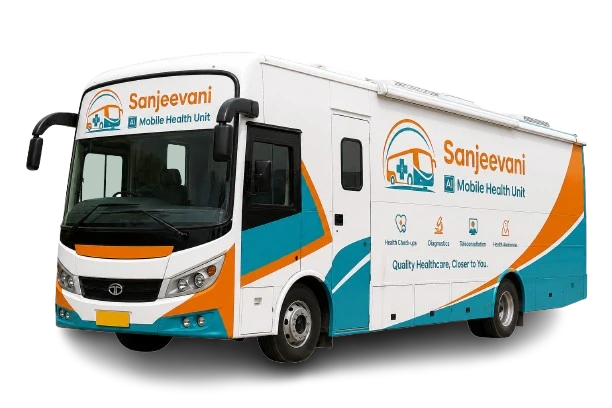
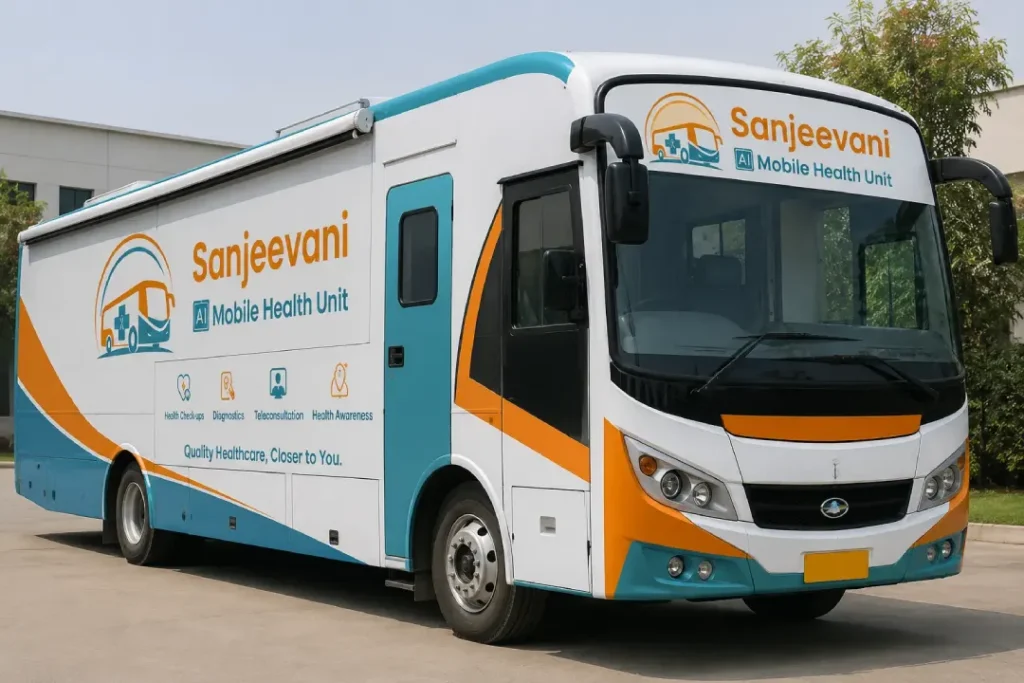
    Sanjeevani is a mobile health unit that brings integrated screening directly to communities. Artificial intelligence reads the images and flags what needs attention. A qualified specialist reviews everything significant before any result is issued — the technology speeds the work up, it does not replace the clinician.

    Cancer

    Breast, cervical and oral

    Tuberculosis

    Digital chest X-ray, AI-assisted

    NCDs

    Diabetes, hypertension, COPD, diabetic retinopathy

    Anaemia

    Point-of-care haemoglobin

    Age-appropriate and risk-based, so nobody is screened for something irrelevant to them.

    Screening is not the end point.

    The part that usually fails in community screening is what happens after. Sanjeevani is built around the follow-through.

    Before the van arrives ASHA and ANM workers go door to door. Dates are fixed with the local government. People register in advance, so the day itself is not spent queueing
    The visit Digital registration and an electronic health record. Screening across all nine conditions. AI-assisted analysis reviewed by a specialist. A teleconsultation before the person leaves.
    Referral Every screen-positive person is connected to treatment — not handed a slip and left to find their own way.
    Follow-up Structured calls confirm that treatment actually started. Screening is not the end point.

    One figure, covering the whole journey.

    ₹4,200 is not the cost of a test. It is the cost of one person completing the entire process — being found, registered, screened across all nine conditions, having results read by a specialist, speaking to a doctor, being referred if needed, and being followed up until treatment actually starts.

    Community mobilisation and registration

    Digital registration and an electronic health record

    Integrated screening across all nine priority conditions

    AI-assisted analysis with specialist interpretation

    Telemedicine consultation

    Referral coordination and structured follow-up

    You are funding an outcome, not a line item.

    Every ₹4,200 completes one journey.

    There is no obligation to fund a whole journey. Give a part of it, all of it, or more — whatever you choose. Once ₹4,200 is raised, one more person is screened, referred and followed up.

    Your contribution People screened What it means on the ground
    ₹4,200 1 person One complete journey — mobilisation, registration, screening for all nine conditions, specialist review, teleconsultation, referral and follow-up.
    ₹8,400 2 people A couple, or a mother and daughter, screened together on the same visit.
    ₹21,000 5 people A household, or five women from one village who would not otherwise be screened.
    ₹42,000 10 people Ten complete journeys — enough to find, on average, several conditions early.
    ₹84,000 20 people A meaningful share of a single camp day.
    ₹4,20,000 100 people An entire village screened, referred and followed up.

    What Sanjeevani has done so far.

    Not built on the live page yet — content pending. There is a marked insert point in the HTML.

    People screened to date
    Camps run
    Districts covered
    Screen-positive cases referred

    A single named beneficiary, in her own words.

    Not built on the live page yet — content pending. Same insert point as Section 8.

    Consented photograph

    Beneficiary quote goes here.

    — Beneficiary name
    100–150 word beneficiary story goes here. The story should describe the person's experience, what was identified, and what happened afterwards, with written consent for the use of the story and relevant health details.

    Telerad Foundation, since 2007.

    Telerad Foundation is a non-profit organisation working to make high-quality healthcare accessible to people everywhere — regardless of geography or economic status. Founded in 2007, the Foundation designs, develops, and implements healthcare programmes in partnership with government agencies, CSR funders, philanthropic organisations, and communities across India and beyond.

    We believe health is a basic human right. All our projects are driven by digital technology — our equipment, software, and operational expertise in telehealth make our programmes highly cost-effective and impactful. Through government and corporate partnerships, we have implemented pioneering telehealth projects in Karnataka, Madhya Pradesh, UP, Gujarat and Rajasthan, and have worked on projects in several African nations.

    Telerad Foundation is a registered charity in India. Donations are tax-exempt under Section 80(G) of the Indian Income Tax Act, 1961.

    Our Vision & Mission

    We envision a world where everyone can access high-quality healthcare, regardless of their social or economic status or where they live. Our mission is to improve the lives of underprivileged, vulnerable, and remote populations through technology-enabled healthcare, catalyse innovative health solutions, and build the capacity of healthcare providers.

    Sanjeevani runs in partnership with government — policy support, community outreach and referral linkages — so care continues after a camp ends.

    Trust Registration No.

    KRI-4-00782-2006-07

    80G Registration No.

    AABTT5871H25BL02

    12A Registration No.

    AABTT5871H25BL01

    CSR-1 Registration No.

    CSR00002867

    PAN

    AABTT5871H

    BEFORE YOU GIVE

    Questions people ask.

    Yes. Donations are exempt under Section 80(G) of the Indian Income Tax Act, 1961. Your receipt is issued to the email address you donate with.

    Then give a part of it. There is no minimum and no obligation to fund a whole journey — a fraction is genuinely useful. Contributions add up, and each ₹4,200 raised takes one more person through the complete process.

    Sanjeevani deploys to locations agreed with local government and community health workers, chosen on need. Your contribution funds people screened at those camps.

    Telerad Foundation publishes audited financial statements, and reports periodically on beneficiaries screened, referrals completed and treatment linkage. [OPTIONAL — delete this question if you would rather not invite it.]

    No. AI assists with reading images and flags what needs attention, but every significant finding is reviewed and validated by a qualified specialist before any result is issued.

    Every screen-positive person is connected to treatment through referral coordination, and followed up by phone to confirm that care actually started.

    Need To Replace

    The van is going out either way. The question is how many people it can see.

    Every ₹4,200 is one more person screened, referred and followed through to treatment.